Salt spreaders seem simple until you are the one depending on them at 4:30 in the morning. Then every little detail matters. How fast it loads. How evenly it throws material. Whether it clogs when the salt is a little damp. Whether the truck still feels right with a full hopper in the back. Those are the things that separate a spreader that looks good on paper from one you are actually glad to own.
If you are buying for a business, a town crew, a facility, or a farm shop that handles its own lots, the question is not really “which spreader is best?” It is “which spreader fits the way we work?” That answer changes depending on the truck, the route, the material, and the people using it.
Start with the material, because winter never gives you perfect salt
A lot of people start by looking at size. That makes sense, but material should come first. Bagged salt, bulk salt, treated salt, sand, and salt-sand blends all behave differently. Dry salt flows pretty easily. Damp material can get stubborn. Sand is heavier and does not always move the way you wish it would.
This is where a salt & sand spreaders dealer is useful, especially if they ask practical questions instead of just pointing at the biggest model. What do you spread now? Is it stored inside or outside? Are you loading by hand, with a skid steer, or from a pile? Do your routes need salt only, or do you need traction material too?
Those questions are not small. They tell you whether you need a lighter-duty setup, a stronger feed system, or a spreader that is better suited for rougher material.
Think about the route, not just the truck
A truck might be able to carry a spreader, but that does not mean the setup makes sense for the route. A small lot behind an office building is different from a long list of commercial stops. A rural driveway route is different from a municipal parking area. Tight spaces, parked cars, loading docks, curbs, and bad lighting all change what feels workable.
A smaller sand spreader can be the right call when the truck needs to stay nimble. You give up some capacity, but you may gain easier handling and less stress on the vehicle. On the other hand, if the driver has to come back and reload every hour, the smaller unit may slow the whole night down.
So walk through a normal storm in your head. Not the perfect storm. A normal messy one. The one where the salt is damp, the second driver is late, and the lot that was supposed to be empty has three cars sitting in the way.
When salt spreaders belong on a pickup
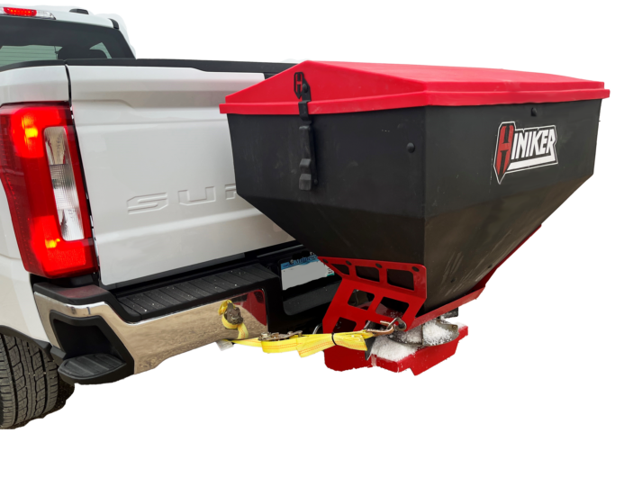
Pickups are popular for a reason. They can plow, spread, move between sites, and still be used for other work when winter is over. But the spreader has to match the truck. Payload matters. So does the rear axle rating, the hitch or mount, and how the truck handles when the unit is full.
For lighter routes, tailgate spreaders are often a good place to start. They are usually easier to install and remove, and they do not turn the truck into a dedicated salt rig. That is helpful for small contractors or property owners who need winter equipment but still use the truck for everyday work.
Bigger hoppers make sense when reload time is costing you. If you have several lots in a row, more capacity can keep the route moving. Just be honest about weight. Salt adds up quickly, and an overloaded truck is not saving you money.
Controls should be boring in a good way
During a storm, nobody wants to fuss with controls that feel confusing. The driver should be able to adjust the spread rate and pattern without thinking too hard about it. Gloves are on. Visibility is poor. The truck may be moving around curbs, islands, or parked vehicles. Simple matters.
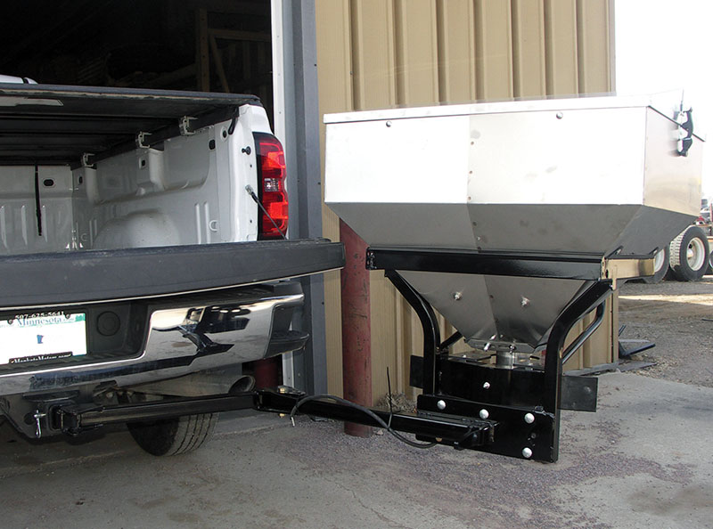
A receiver hitch spreader can make sense for lighter work or for someone who wants a setup that comes on and off without a lot of drama. It is not the answer for every job, but for the right route it can be a very clean setup.
Pay attention to how the spreader feeds material too. If it bridges, clumps, or throws inconsistently, the driver starts compensating. That usually means wasted salt in one spot and not enough in another.
Do not ignore the ugly parts of ownership
The buying process tends to focus on capacity and price. Fair enough. But the boring ownership stuff is what you live with after the first storm. Can you clean it easily? Can you reach the spinner, wiring, and feed areas? Where will it sit in April? Can one person remove it safely, or does it take a forklift and three favors?
Salt is hard on equipment. Everyone knows that, but it still surprises people how fast corrosion can show up when cleaning gets skipped. A spreader that is easy to rinse and inspect is more likely to get taken care of. That means fewer stuck parts and fewer bad mornings.
Parts support matters too. If something quits in January, you do not want to discover that replacement parts are a week out. Ask about service before you buy. It is not the exciting part, but it may be the part you appreciate most.
A simple way to compare salt spreaders
When you are down to a few choices, compare them by real use. Vehicle fit. Loaded weight. Material type. Capacity. Controls. Cleaning access. Parts availability. Dealer support. Those are the pieces that usually matter once the weather turns.
It also helps to be honest about growth. If you expect to add work next season, buy with a little room. If your route is steady and local, there is no need to overbuy just because a larger unit looks more serious.
The best salt & sand spreaders setup is the one that feels natural after a few storms. It loads the way your crew works. It spreads the material you actually use. It fits the truck without making it miserable to drive. And when the night gets long, it keeps doing its job without becoming the problem.
FAQs
How do I know what size spreader I need?
Start with your route. If you only handle a few small lots, a smaller setup may be easier to live with. If you are reloading all night, then more capacity might be worth it.
Are salt spreaders worth buying before the season starts?
Yes. Waiting until the first icy forecast usually limits your options. Buying earlier gives you time to choose the right fit, install it properly, and fix small issues before they become storm-night problems.
Can salt spreaders handle sand too?
Sometimes they can, but do not assume it. Sand is heavier and can be harder to move through the hopper. If you plan to spread sand or a salt-sand mix, make that clear before buying.
Reach out to us online at Hiniker or contact us today by calling (800) 433-5620 to find out more about the premium snow removal products we offer.
We have been a proud Minnesota-based manufacturer since 1995. We offer the highest quality salt & sand spreaders, snow plows, skid steers, truck plows, accessories, and more!

Our equipment at Hiniker is built to enable the operator to work as efficiently as possible.
You can also follow us on Facebook for the latest news regarding Hiniker’s premium equipment and accessories.